

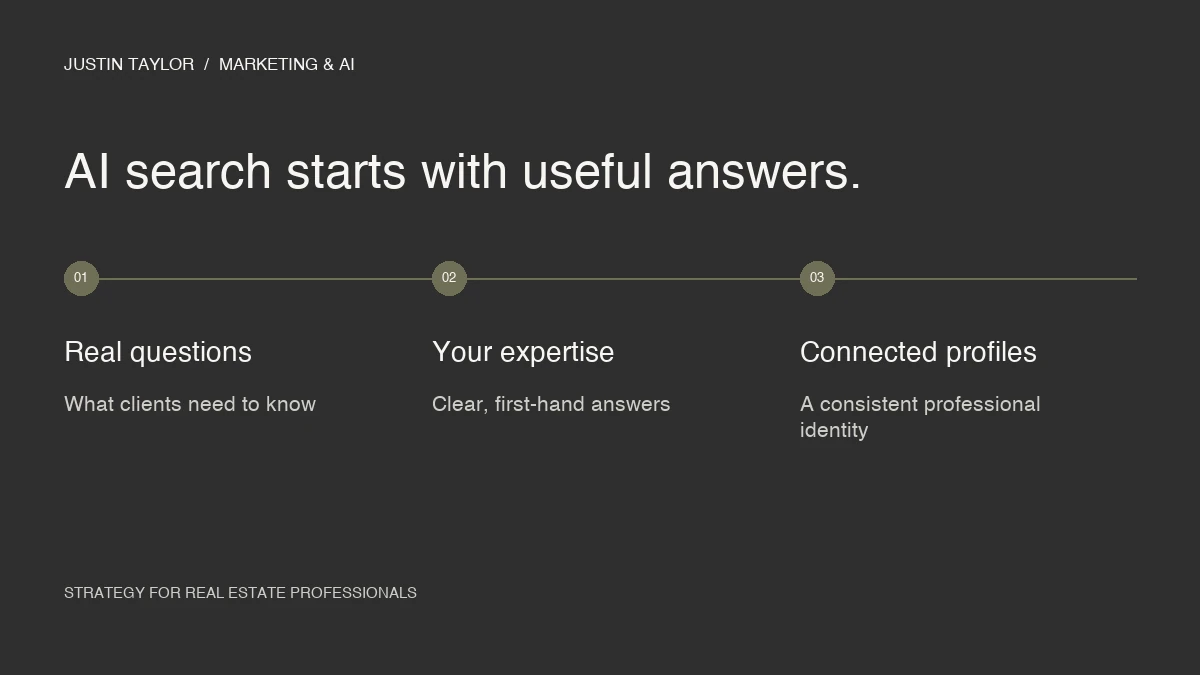
AI search gives real estate agents another place to be discovered. A prospective client can ask a detailed question about a move, compare ways to approach a sale, or research a professional before contacting anyone. Your website needs to make your experience, services and local knowledge easy to understand in that setting.
The starting point is a useful, accessible website with specific answers. You do not need to rebuild your marketing around every new AI feature. Start with the questions your clients already bring to you and the pages that explain who you are.
What do SEO, AEO and GEO mean for an agent?
Search engine optimization, or SEO, helps search engines discover and understand your pages. Answer engine optimization, or AEO, focuses on making your information useful when a system answers a question. Generative engine optimization, or GEO, usually describes efforts to improve visibility in answers produced by generative AI. The terms overlap, and platforms do not all work the same way.
HubSpot’s AEO guide recommends organizing content around audience questions and supporting answers with clear evidence. For a real estate agent, that could mean replacing a broad article about “buying a home” with a useful explanation of how to prepare for a first neighborhood visit.
For Google specifically, Search Central says its existing SEO fundamentals still apply to AI Overviews and AI Mode. A supporting page must be indexed and eligible to appear with a search snippet. Google does not require a special AI file or a new type of schema, and eligibility does not guarantee inclusion.
Build one page around a real client question
Choose a question you can answer with detail that comes from doing the work. “What should I look at before choosing a neighborhood?” offers more room for useful local guidance than a page that repeats your city name and calls you the best agent.
Imagine a buyer planning a weekend visit to Mesa. An agent could create a guide titled “Planning a Home Search Visit to Mesa: What to Prepare.” The page might explain how to organize appointments, what information to bring and how to record observations between properties. This is a content example, not a claim about current market conditions.
A PAGE WORTH BUILDING
Question: How can I make a short home search trip more productive?
Useful answer: Prepare a shortlist, group appointments by location, leave travel time and decide what you want to compare before the first visit.
Your contribution: A sample itinerary, a blank comparison sheet and your explanation of how you help a client plan the visit.
Answer the main question near the top. Then add the details that help someone act. Explain which parts are examples and which depend on their situation. Include an author name, a way to contact you and links to related information. When you use current figures, identify the source and date so a reader can check them.
Before publishing, ask whether the page would still be useful if a reader never became a client. If the answer is no, add the missing explanation, example or next step.
Make your professional identity easy to follow
Read your website biography, brokerage profile, Google Business Profile and social introductions side by side. Would a stranger recognize the same professional across all four? Correct old affiliations, broken contact links and conflicting descriptions of the areas you serve.
This is also a practical client experience check. Someone who watches a video and then searches your name should arrive at information that supports what they just heard. Your biography can explain your experience; your service page can explain how you work; your articles can demonstrate how you think.
Give each page a job. Link a neighborhood planning article to the relevant service page. Connect a detailed video to a written guide. For profile basics, use the Google Business Profile guide for real estate agents. These connections make the next step clearer for readers.
Use AI to organize your knowledge
AI can help sort questions, suggest an outline or identify an explanation that feels incomplete. Start with notes from your own work, with private client details removed. A useful prompt is: “Group these questions into topics. Suggest a separate page for each distinct client need. Flag anything that requires current local research.”
Then supply the substance yourself. Add the example you would use in a conversation. Check every factual statement. Remove claims about your experience, results or market that the tool invented. Read the draft aloud and replace sentences you would never say.
A team can make this repeatable: one person collects questions, one contributes the relevant experience and one checks the finished page. Put a review date on content that depends on changing information. The goal is to make publishing easier while keeping the information dependable.
Measure progress without chasing one AI answer
Keep a short record of the questions you want to be useful for, the pages addressing them and the inquiries those pages produce. If you test an AI answer, save the prompt, platform and date. Treat the result as an observation, not a permanent ranking.
Watch website search traffic and meaningful actions such as contact requests. Ask new contacts what they read or watched before reaching out. Those conversations can reveal which explanations deserve a follow-up article.
Keep the first month simple: clarify your biography and services, publish one strong answer, connect it to an existing page and review what people do next. Build from the questions that remain unanswered. You can also explore how Justin helps with search and discovery.
Common questions
Can an agent guarantee a mention in ChatGPT or Google’s AI answers?
No. Clear content and a consistent professional presence can support discovery, but you do not control which sources a platform selects. A service promising guaranteed inclusion should explain exactly what it can actually deliver.
Should every article be written as an FAQ?
No. Choose the format that serves the question. A process may need steps, a comparison may need a table, and a local guide may need a map or original photographs. Give the reader a complete answer in the format that makes it easiest to use.
Sources & further reading
Platform guidance and research referenced in this article. Reviewed September 27, 2026.

Growth & Strategy Manager at Inspire Title Team | WFG Title. Marketing and AI guidance for real estate professionals.