
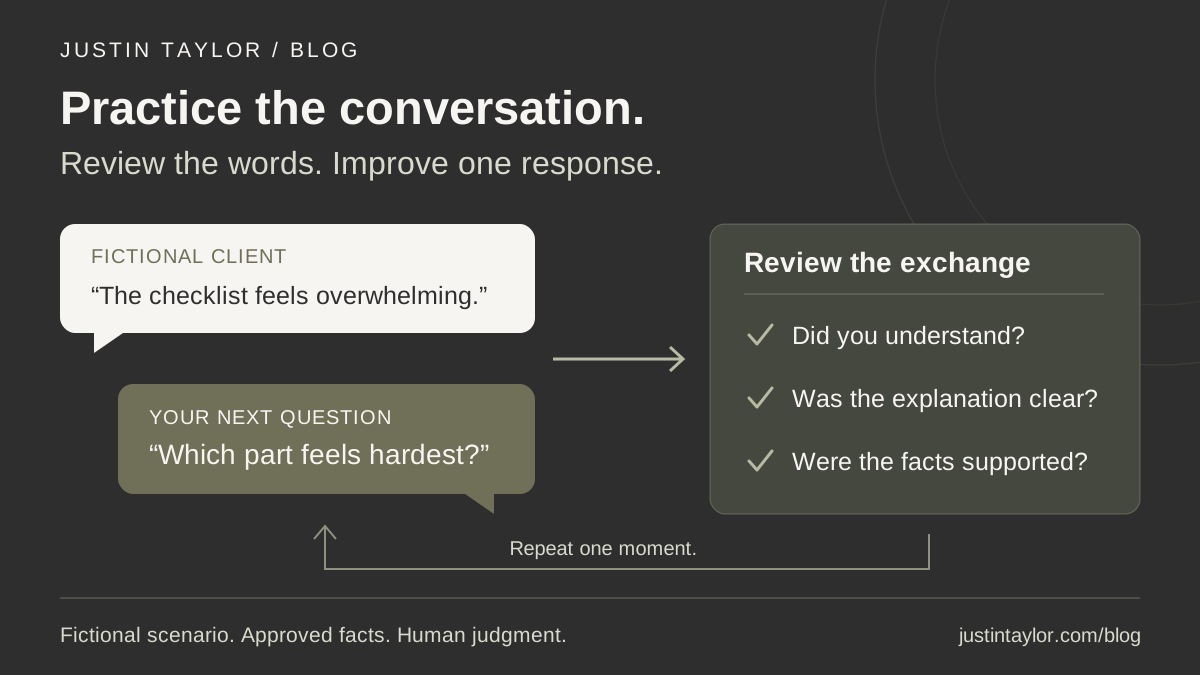
To use AI for real estate consultation practice, give an approved assistant a fictional client scenario and ask it to respond one turn at a time. Practice one skill, such as clarifying a concern or explaining a preparation step. Then review the actual exchange, check the advice against your approved process and repeat the moment that needs work.
The useful outcome is a clearer question or explanation you can use in a real conversation. A simulated client agreeing with you is not evidence that your approach will work with buyers or sellers.
HubSpot’s small-business AI guide, updated October 21, 2026, recommends starting with a defined business problem when choosing a tool. Apply that principle to a familiar difficulty: an agent knows the process but struggles to explain it without delivering a long monologue. A short rehearsal gives that agent something concrete to review.
Choose one moment in a consultation
“Practice selling a home” asks too much of one exercise. Pick a moment with an observable finish: understand why a seller feels overwhelmed by preparation, explain what happens at an introductory meeting or help a buyer organize questions for a showing.
HubSpot’s AI-in-sales guide, updated September 29, 2026, describes roleplay as a way to get practice repetitions and feedback. The exercise below applies that idea to real estate communication. It does not evaluate transaction advice or replace a brokerage’s training requirements.
For the first scenario, imagine a seller who wants to discuss preparing a home but feels every online checklist demands a large project. The agent’s task is to understand what feels difficult, explain the purpose of a preparation conversation and agree on one useful next step. The seller is fictional; no listing, address, budget or client history is needed.
Choose a different situation if that one is not relevant. A team leader might practice explaining an onboarding process. A lender might rehearse how to organize questions for an introductory appointment, using the organization’s approved explanation rather than inventing product terms.
Write a scenario card and supply the approved facts
Keep the scenario short enough to check at a glance. Separate what the fictional person wants from what the professional is allowed to claim.
| Part | Practice setup |
|---|---|
| Situation | A seller has read several preparation checklists and feels overwhelmed. |
| Communication skill | Ask what concerns the seller before explaining a process. |
| Approved information | The team’s actual consultation agenda and preparation handout. |
| Missing information | No property condition, sale timeline, costs or expected results have been supplied. |
| Useful finish | Summarize the concern and propose a relevant next conversation or resource. |
Use your organization’s approved tool and suitable reference material. Supply only the process details the exercise needs. A fictional scenario avoids uploading a real client’s private messages or recording to get started. The AI knowledge-base guide explains how to keep approved process documents separate from style examples and outdated drafts.
Google’s prompting guidance recommends clear instructions, relevant context and separate prompts for complex tasks. Here, separate the conversation from its review: the assistant first plays the fictional client, then assesses the exchange when you explicitly stop.
Run a short exchange without asking for a script
COPY AND ADAPT
Help me rehearse a real estate consultation. Play the fictional client described in the scenario card below. I will respond as the agent. Begin with one short concern, then wait for my reply. Continue one turn at a time. Do not write my answers, coach me mid-conversation or agree just to end the exercise. Stay within the scenario; do not invent property facts, market figures, company policies or results. After four of my replies, or when I type “review,” stop the roleplay. Identify useful questions, missed concerns and claims needing verification, if any. Quote the relevant words and compare factual claims with the approved notes. If the exchange does not support a judgment, say so. Scenario and approved notes: [insert].
Use your normal language. If you need a moment to think, take it. The point is to observe how you explain the situation, not to have the assistant produce both sides of a polished dialogue.
If the assistant starts inventing details or coaching during the simulation, pause and restate the boundary. Discard a session that wanders too far from the scenario. You are testing whether the tool follows the assignment as well as practicing your own response.
You can begin in text and read your replies aloud. For optional spoken practice, Claude’s current voice-mode documentation describes starting a chat and selecting the sound-wave control; on mobile, it sits beside the microphone icon. You can switch between text and voice in the same conversation. Voice is a beta feature and counts toward your plan’s usage limits. Check the linked instructions for your device before starting.
Review what you actually said
Ask for observations tied to specific turns. “Great empathy” is difficult to use. “You asked which part of the checklist felt hardest before suggesting a resource” identifies a behavior you can recognize and repeat.
- Understanding: Did you clarify the concern before proposing a solution?
- Clarity: Did you explain the next step in familiar words?
- Accuracy: Did your explanation stay within the approved facts?
- Choice: Did you invite a response and respect hesitation?
- Follow-through: Did the proposed next step address the concern raised?
Check the feedback yourself. Google’s Gemini guidance notes that AI suggestions can be inaccurate. An assistant may praise a confident but unsupported answer or misunderstand why a question matters. Use the AI fact-checking process for claims that enter the conversation, and ask a knowledgeable colleague to review important process explanations.
Keep the exercise focused on the words exchanged. A text transcript cannot establish how attentive you looked, whether your tone reassured someone or how an actual client felt. An AI-generated score is not a validated measure of professional competence.
Repeat one moment with a better question
Suppose the fictional seller says, “Every checklist makes it sound like I need to redo the whole house.” An unhelpful practice response might promise that preparation will be easy before learning what concerns them.
A more useful question could be: “Which part feels hardest to take on right now?” After hearing the answer, the agent can explain the relevant part of the team’s actual process. This is an illustrative communication choice, not a required script or a claim that a particular property needs no work.
Restart from that sentence and practice again. Change one behavior, such as asking a clarifying question before explaining. Then try a fresh scenario with the same skill. That helps reveal whether you learned an approach or simply memorized a reply.
Bring the useful lesson back to your work
Save a brief practice note: the scenario, the skill, the sentence you changed, the source you checked and what to try next. A team can compare observations using the same questions above, while keeping the conversation supportive and specific.
Useful rehearsals can also reveal content gaps. If your explanation of a first meeting repeatedly gets tangled, improve the meeting handout or draft a clearer website answer from approved notes. Do not publish the fictional exchange as a client story or testimonial.
Start with one scenario and a few turns. Judge the exercise by whether it produces a more accurate explanation or a better question, not by invented conversion predictions. Justin’s AI training for real estate professionals can help connect tools, practical assignments and human review to the work your team does every day.
Sources & further reading
Platform guidance and research referenced in this article. Reviewed October 27, 2026.

Growth & Strategy Manager at Inspire Title Team | WFG Title. Marketing and AI guidance for real estate professionals.