
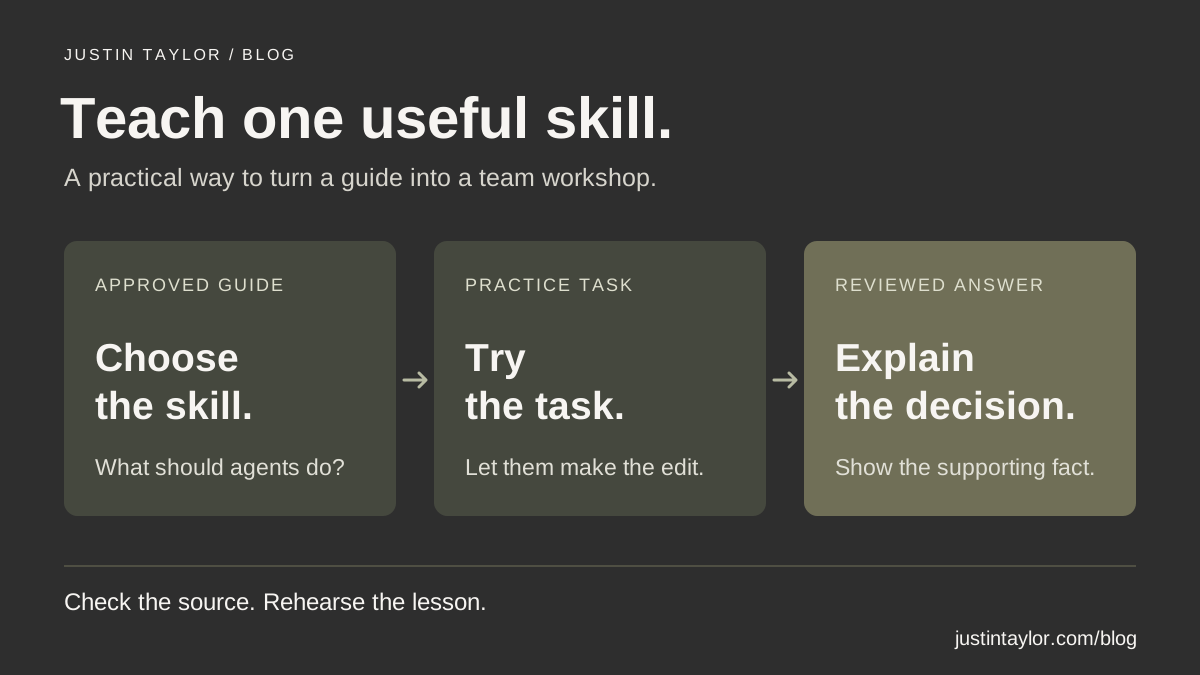
To turn an existing real estate guide into a team workshop with AI, choose one skill to teach, supply the approved source material, and ask for a short lesson plus a practice task. Check the answer key yourself before presenting. The useful result is something an agent can do after the session, not simply a shorter version of the guide.
A brokerage leader might already have a strong guide to community pages, seller communication or preparing for an initial consultation. AI can help organize that material into a teaching sequence. The leader still decides what matters, supplies the examples and checks whether the exercise actually tests the skill.
HubSpot’s guide to writing with AI, updated November 17, 2026, emphasizes clear briefs and human editorial judgment. The same preparation is useful when changing formats. For a workshop, however, the brief also needs an observable learning outcome and a way for participants to practice it.
Choose one skill an agent can demonstrate
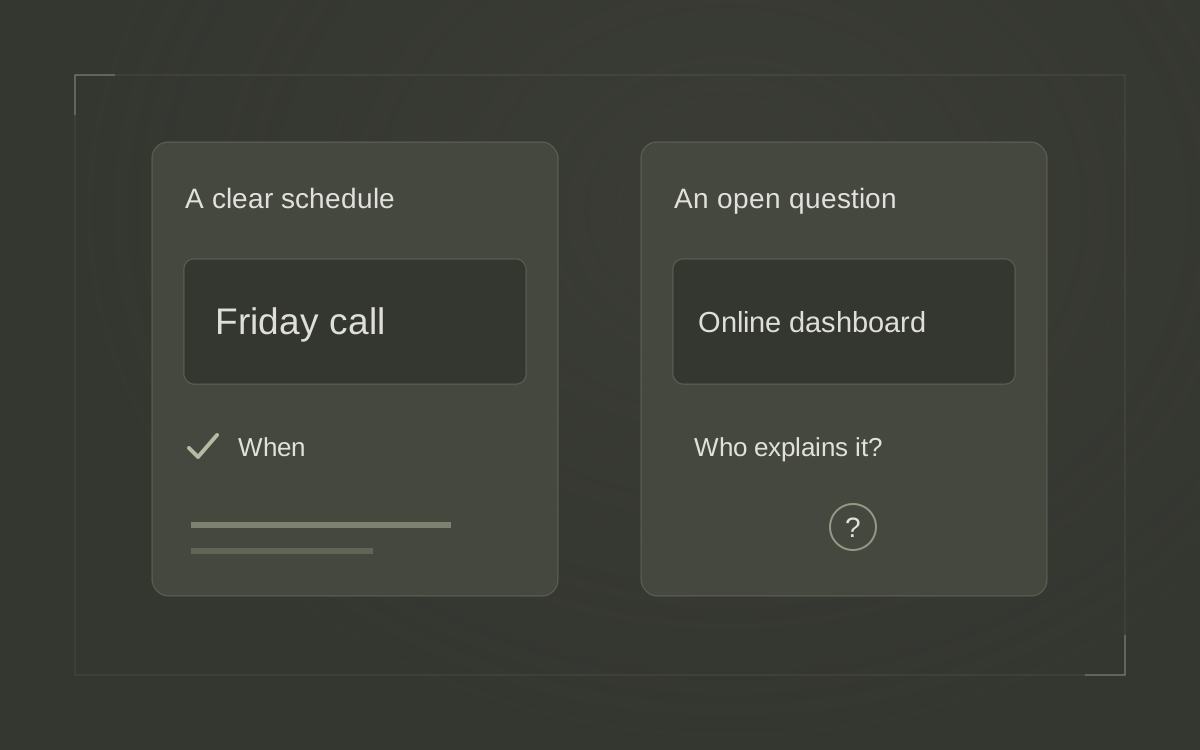
“Understand community marketing” is too broad for a short team meeting. “Rewrite a community-page paragraph so each factual claim has support” gives the presenter and the participants a concrete target.
Use that second objective for a proposed 20-minute session. An agent should leave able to identify an unsupported statement, replace it with a supported detail and name what still needs verification. Justin’s community-page guide offers background on using local evidence and separating observations from assumptions.
Write the objective before opening an AI tool. Then decide what will count as completion: a revised paragraph with source notes and one unresolved question. That gives you a practical way to judge the session beyond whether people liked the presentation.
Prepare a small teaching packet
Begin with three clearly named documents: the guide you are teaching, a workshop brief and a practice example. Use material you own or have permission to use. Remove client details and follow your organization’s rules for AI tools.
The workshop brief should specify the audience, their starting knowledge, the time available and the finished task. Add boundaries: this session teaches editing local information; it does not evaluate a real neighborhood or establish facts about a property.
Make the practice example deliberately small. A paragraph with three problems is enough to reveal whether someone understands the method. Supplying that example yourself also lets you decide the correct answer before seeing an AI-generated one.
If your source material is scattered, the AI knowledge-base guide explains how to organize approved information. For this workshop, select only the documents needed for the lesson.
Use a notebook to keep the sources visible
Google’s Gemini Notebook overview describes source-based chat with citations. Browser access depends on supported location and account requirements. For work or school accounts, feature availability and data handling depend on the license. Use an account your organization permits for this work.
For the desktop workflow, follow Google’s source instructions:
- Open Gemini Notebook and create a notebook for this workshop.
- Select Add sources on the left. Add the approved guide, brief and practice material as supported files or pasted text.
- Use clear source titles, then select the sources you want the chat to use.
- Inspect the imported material before drafting. A webpage import brings in its text, not its embedded videos or images.
Keep the exercise and its reference facts in the sources. This makes it easier to ask for an answer key tied to the actual teaching material instead of inviting the model to invent a local example.
Ask for a session plan with room to practice
Start with the agenda. Review what it teaches before asking for speaker notes or a handout. Here is an original prompt to adapt to your own documents:
Using only the selected Guide, Workshop Brief and Practice Example sources, propose a 20-minute team workshop. The outcome is that an agent can revise a local-information paragraph using supported facts and identify what remains unknown. Include a short demonstration, individual practice and a discussion of the answer. Cite the source behind each teaching point. Mark missing information instead of filling it in. Do not add facts about real communities.
A workable agenda could look like this. These timings are a proposed format, not a measured result.
| Time | Activity | Participant’s task |
|---|---|---|
| 3 minutes | Introduce the skill | Explain the difference between a documented fact and an assumption. |
| 4 minutes | Demonstrate one edit | Follow a claim back to its source. |
| 6 minutes | Practice independently | Revise the sample paragraph and mark the unknowns. |
| 5 minutes | Compare decisions | Explain what changed and why. |
| 2 minutes | Choose an application | Name one draft to review with the same method. |
If the AI returns a long lecture, reduce the teaching points. Preserve the practice time. A presenter needs to see participants make a decision, not just watch them read a list of tips.
Give the exercise a checkable answer
Use this fictional training example as a model. It describes no actual park, property or public directory and should never be published as local information.
- Sample reference A: an imaginary park directory lists a walking path and picnic tables.
- Sample reference B: an imaginary map shows two park entrances.
- Missing information: neither reference supplies opening hours or travel times from a home.
The intentionally flawed draft is: “Enjoy the best park in town, five minutes from home, with trails that are always open.” Ask participants to rewrite it using only the sample references.
One acceptable practice answer is: “The sample directory lists a walking path and picnic tables, and the sample map shows two entrances. Check the park’s current hours and the route from the specific property before planning a visit.”
The learning is in the explanation. “Best” adds an unsupported judgment. “Five minutes” needs a starting point and travel method. “Always open” needs current hours. The replacement identifies documented features and preserves the questions the references cannot answer.
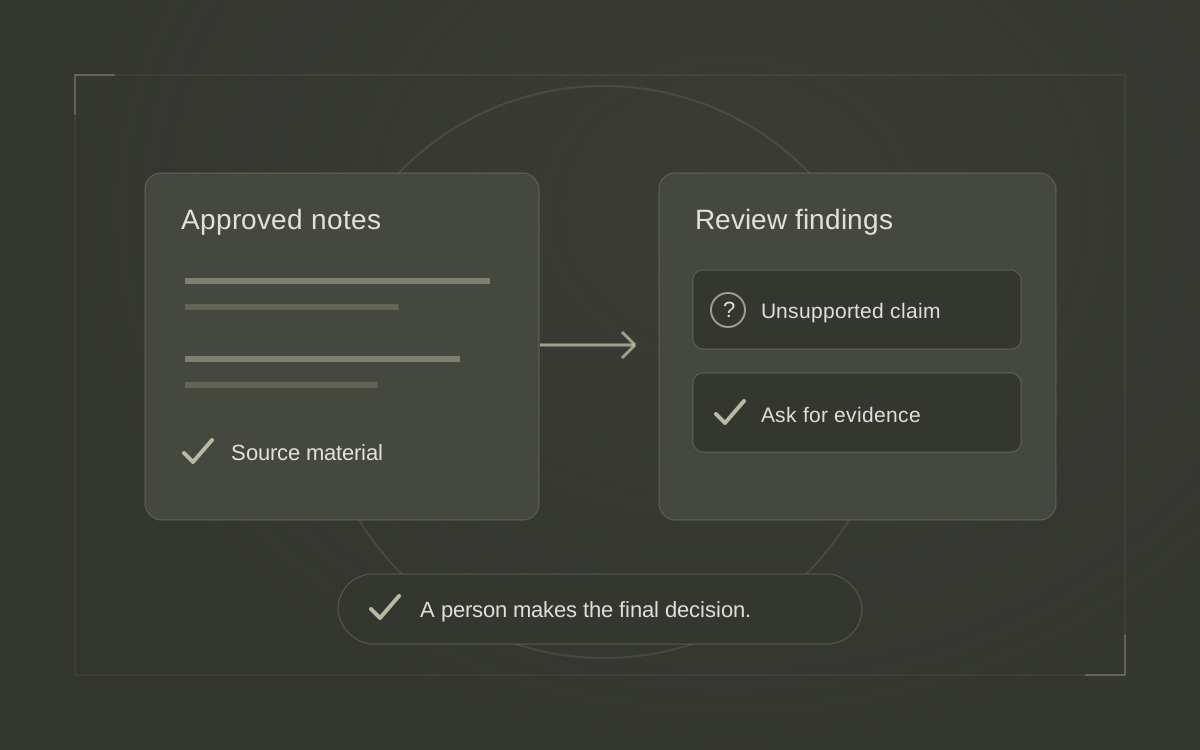
Ask the AI for a facilitator’s answer key that lists each issue, the supporting source and acceptable variations. Compare that key with your own reasoning. Do not let the generated key become the authority merely because it sounds confident.
Review the teaching points and rehearse the session
Google’s chat documentation explains that selecting a citation opens the supporting passage in context. Use that to check each teaching point. A citation is a route back to evidence; you still need to decide whether the passage supports the claim.
Read the lesson aloud, complete the exercise yourself and check the timing. Remove repeated explanations and jargon. Label every fictional example on the participant handout as well as in the presenter notes, so it cannot become detached from its context.
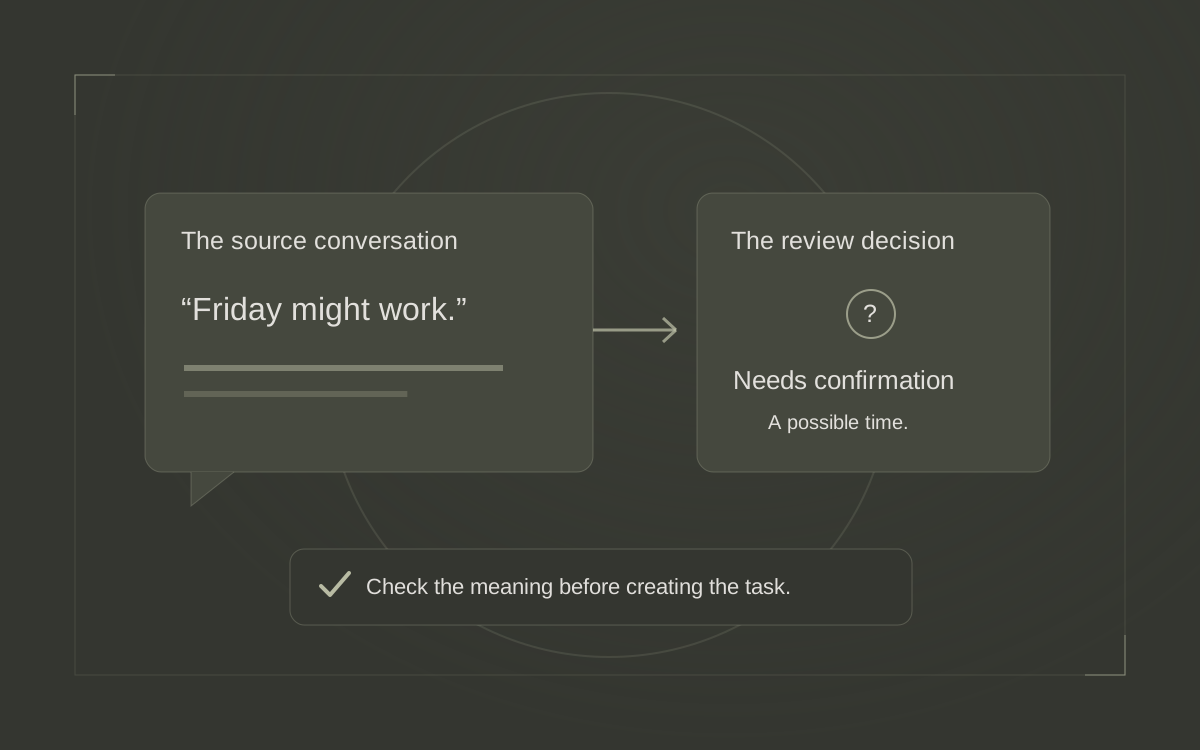
For this exercise, a completed answer should do three things: remove the unsupported claims, retain useful supported details and explain what still needs checking. Accept different wording when it meets those criteria. If a response misses the point, ask the participant to show the source behind the sentence.
Keep the lesson connected to the work
End by choosing one real draft for later review through the team’s normal approval process. In the next meeting, discuss which statements were easy to verify and which required more research. Use those questions to improve the workshop.
Save the reviewed lesson, exercise, answer key, source list and review date together. Google notes that changing or deleting a notebook source does not change Studio outputs already generated from it. Recheck saved teaching materials when their source guidance changes.
Justin helps real estate professionals build practical AI workflows around their own knowledge and daily work. Explore AI training for real estate professionals or start a conversation about the skill your team needs to practice next.
Sources & further reading
Platform guidance and research referenced in this article. Reviewed November 18, 2026.

Growth & Strategy Manager at Inspire Title Team | WFG Title. Marketing and AI guidance for real estate professionals.