
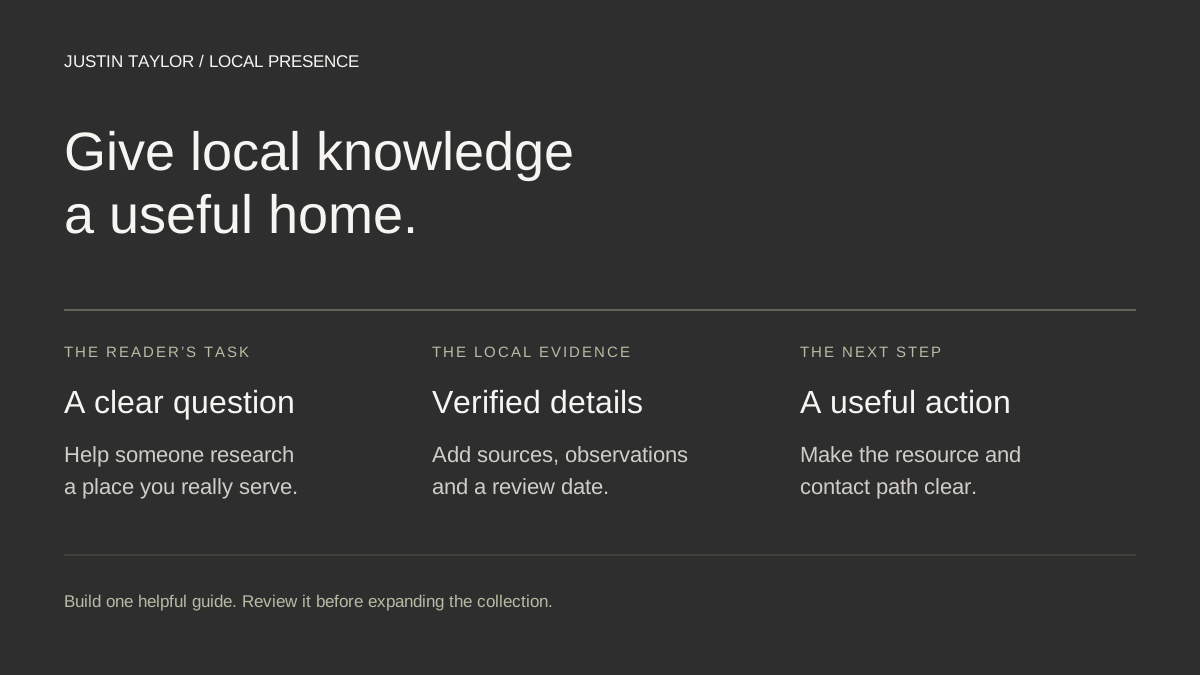
A useful real estate community page helps someone research a specific place and decide what to investigate next. Build it around local questions, reliable sources and your own relevant knowledge. Start with one area you genuinely serve, give the page a clear purpose, and publish it when it can stand on its own.
You do not need a page for every city on the map. A short, well-maintained collection of community guides can give a prospective client more help than dozens of pages with interchangeable introductions and the same contact form.
Semrush’s multi-location SEO guide, dated October 7, 2026, emphasizes preserving local substance as a business expands its website. For real estate professionals, that raises a useful planning question: what can a reader learn on this area page that they would not learn from your general biography?
Decide what the page is there to do
Before choosing a title, write down the visitor’s task. “Research an area before planning a visit” is different from “find the brokerage office” or “understand how this agent helps sellers.” Each deserves a different emphasis.
| Page | Question it should answer |
|---|---|
| Community guide | What can I learn about this area, and where can I verify the details? |
| Service page | How does this professional help buyers or sellers here, and what happens when I reach out? |
| Office page | Where is the actual office, who works there, and how do I arrange a visit? |
A community guide can explain that an agent serves an area without suggesting the agent has an office there. Label an office only when it is a real operating location. Keep that distinction in page headings, maps, contact details and any structured data.
A new website page does not establish eligibility for another Google Business Profile. Google’s business guidelines require accurate real-world representation and include separate rules for individual practitioners such as real estate agents. A rented mailing address where the business does not operate is not an eligible virtual office.
Choose one local question worth answering
Start with questions from recent consultations, with private client details removed. Look for a question that requires local context rather than an answer you could give for any market.
For example, imagine an agent helping a buyer plan an initial visit to the Phoenix area. The buyer wants to organize the research before scheduling tours. A community guide could help them collect official map links, identify places they want to visit and prepare questions about individual properties. This is a hypothetical content brief, not a claim about a particular neighborhood.
Use that brief to decide what belongs on the page. A visitor planning a research trip needs clear orientation and a way to keep notes. A long history essay or a generic paragraph about an “unbeatable lifestyle” may not help with that task.
If several proposed pages would answer exactly the same question with the same material, begin with one broader guide. Add a separate area page when you have a distinct answer to offer. Google’s doorway-abuse policy addresses substantially similar pages created for related searches that funnel visitors elsewhere. Changing the city in a template does not create useful local knowledge.
Build an evidence sheet before writing
For each detail, record the claim, its source, when you checked it and what might change. That small preparation step makes drafting easier and gives you a maintenance plan afterward.
- Official information: start with the relevant municipality, county, transit operator or facility’s own website. Link to the page that answers the question, rather than a broad homepage.
- Personal observations: use notes and photographs from your own visit, where you have permission to share them. State what you observed and when.
- Property-specific questions: identify what a reader needs to verify for an individual address instead of presenting an area-wide assumption as an answer.
- Changing details: give schedules, fees and market figures an explicit source and date, or direct readers to the current source instead of copying a number that may become stale.
Keep observation separate from inference. “Here is the operator’s route map” is more precise than promising that every property offers an easy commute. Describe what readers can verify and let them evaluate it against their own priorities.
Google’s people-first content guidance asks whether content demonstrates experience and helps readers accomplish their goal. For a community guide, that means adding context to the sources: explain which question each resource helps answer.
Turn the research into a usable guide
For the hypothetical visit-planning page, try this structure. The headings are an editorial starting point; fill them with verified information about the actual area.
- What this guide covers. Name the area and explain the scope. Clarify whether you mean a municipality, a named neighborhood or a broader service area.
- Where to begin your research. Introduce a few relevant official resources. Explain what to check on each one and why it matters for planning a visit.
- What to observe in person. Offer a short note-taking checklist: places to visit, routes to test and questions to ask. Avoid presenting one visit as a complete assessment.
- What depends on the property. Identify details that require address-level confirmation. Leave space for questions to discuss during the property research process.
- How to prepare for a conversation. Tell readers what to bring: areas of interest, their timing and the questions they have not resolved.
Add an original photograph with an accurate caption if it helps orient the reader. A short video can demonstrate how to organize the research, but put the important explanation in readable text too. The YouTube planning guide can help you turn one local question into a focused video.
End with a specific next step such as “Discuss your visit plan.” Explain what the reader can expect from that conversation. Someone should understand the invitation without having to decode a vague “Get started” button.
Give the guide a clear place on the website
Use a simple structure that readers can browse. For example, a Communities overview could link to /communities/area-name/. That is a sample pattern, not a requirement to change URLs that already work.
Write a descriptive title such as “[Area name] Community Guide: Plan Your First Visit.” Add a concise description of the page’s actual value. Keep the wording natural; repeating the city in every heading makes the page harder to read.
Link to the guide from the Communities overview and from a relevant article or service page. Link back to the overview so someone can continue browsing. Google recommends crawlable links with descriptive text and at least one internal link to every page you want people to find. The content-cluster guide explains how to organize those connections.
Have your website editor check the page’s structured data against the visible content. Google’s structured-data rules prohibit misleading or irrelevant markup. Do not label an invented branch office or address simply because the guide discusses that community.
Review one page before expanding the collection
Open the finished guide on your phone. Follow every resource link, view the images and test the contact route. Then ask someone unfamiliar with the draft to find one resource and explain the next step back to you.
Assign an owner and a review date. Check changing details before sharing the guide again, and update the visible review date after a meaningful review. Use the local citation audit to keep the professional information surrounding the guide consistent with your other profiles.
Judge the first page by the questions it resolves and the quality of the conversations it supports. Search visibility can be another signal, but publication alone guarantees neither rankings nor inquiries. Improve what readers find confusing before producing the next guide.
Justin helps real estate professionals connect accurate profiles, useful website destinations and a clearer local presence. Explore local presence support or start a conversation about the information your clients need next.
Sources & further reading
Platform guidance and research referenced in this article. Reviewed October 8, 2026.
- Semrush: Multi-location SEO: How to build a scalable strategy — October 7, 2026
- Google: Guidelines for representing your business
- Google Search Central: Spam policies — doorway abuse
- Google Search Central: Creating helpful, reliable, people-first content
- Google Search Central: Link best practices
- Google Search Central: General structured data guidelines

Growth & Strategy Manager at Inspire Title Team | WFG Title. Marketing and AI guidance for real estate professionals.