
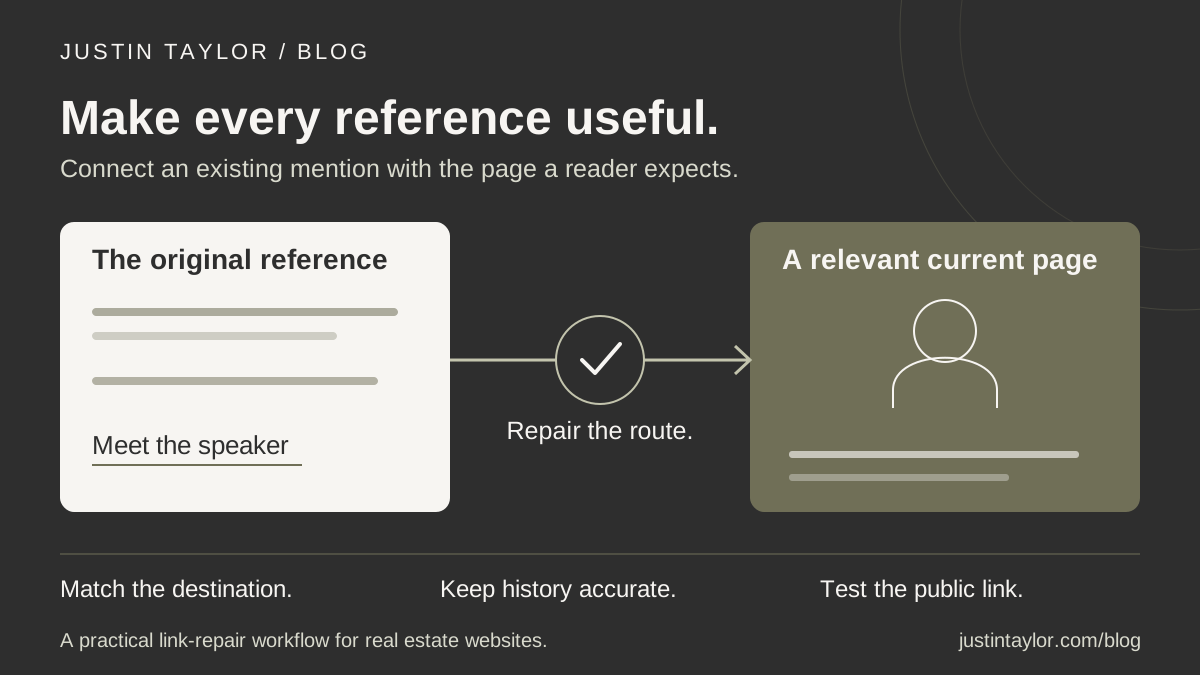
To fix an outdated link to your real estate website, identify the page containing the link, follow its exact destination and choose the closest useful replacement. Then correct the link where you have editing access, request a publisher update or arrange a permanent redirect from a URL you control. Finish by testing the public route.
A speaker biography, community interview or partner resource page can keep sending visitors to an old address long after a website changes. Those references are worth reviewing because someone interested in your work may already be following them. The goal is to help that person reach the information the link promised.
Semrush’s AI search strategy guide, dated October 23, 2026, distinguishes problems with access from problems with how a brand is described. Its emphasis on current, consistent evidence offers a useful starting point here: before commissioning more content, check whether existing references still connect people to the right professional and resource.
Find the exact path that needs attention
Start with references you recognize: your association profile, current brokerage biography, past speaking engagements, interviews and useful resources other organizations have linked to. Search your professional name alongside a former business name or an article title when you need to locate an older mention.
For links to your verified website property, Google Search Console’s Links report offers another starting point:
- Open Links and find External links.
- Under Top linking sites, select More.
- Select a referring site, then one of your target pages, to see the linking pages.
- Open the source page and follow the link yourself.
The report is a sample, not a complete inventory. It can include links found previously that have since disappeared, and target pages are grouped by canonical URL. Record the actual link on the publisher’s page rather than assuming the report shows its exact current destination.
Keep three addresses separate in your notes: the source page, the URL its link uses and the final page after any redirect. A link can look correct in the visible text while pointing elsewhere. Also distinguish an unlinked mention from a broken link; the first is an optional editorial request, while the second is an existing route that fails.
Choose the destination before requesting a change
Read the sentence surrounding the link. It tells you what the reader expects. A name in a speaker biography usually calls for a current biography; a promise of a worksheet calls for the worksheet or a page that clearly provides it. Your homepage is appropriate only when it fulfills the original purpose.
| What the source promises | What happens now | Useful correction |
|---|---|---|
| Meet the workshop speaker | An old biography URL returns an error. | Point to the current biography for the same professional. |
| Download a showing notes sheet | The file moved during a website rebuild. | Link to the maintained resource page containing that sheet. |
| Read the agent’s community guide | The link lands on an unrelated home-search page. | Use the current guide for the same community and task. |
| Visit a former company | The company has closed and its website is unavailable. | Ask for an accurate clarification or removal of the unusable link; do not present an unrelated business as its replacement. |
Check the proposed replacement on a phone before sending it anywhere. Does it identify the right person, explain the resource and provide a working next step? A technically functioning page can still disappoint someone who expected a specific answer.
Keep accurate history intact. A dated announcement about a former role does not need to be rewritten as if you held today’s role at the time. If the page’s personal website link is obsolete, request that specific correction while preserving the original event and affiliation. The local-profile audit helps separate current-profile inaccuracies from valid historical references.
Repair old URLs you control
If a page permanently moved and you control the old address, ask your website provider to map it to the equivalent current page. Google recommends permanent server-side redirects where possible; HTTP 301 and 308 indicate a permanent move. The implementation depends on the hosting environment.
Give the provider an exact pair of addresses rather than “redirect the old website.” For a hypothetical workshop biography, the request might be: move /speakers/alex-rivera/ directly to the current /about/alex-rivera/ page. Confirm the new biography exists first. These paths illustrate the handoff; they are not pages on Justin’s website.
Google’s site-move guidance warns against sending many old URLs to an irrelevant destination such as the homepage. It also recommends updating internal links and aligning the destination’s canonical and sitemap information with the new URLs. Ask the provider to check those details rather than leaving the redirect as the only change.
If the content has no useful replacement, do not invent a thin page solely to catch the old link. Decide whether the original resource is still worth maintaining. Otherwise, ask the source to remove the unusable reference or link to a genuinely relevant alternative.
You cannot configure a redirect on a domain or former brokerage site you no longer control. Record that limitation and work on the source link or your own current information. Keep existing working URLs stable when possible; a new headline does not automatically require a new address.
Make the publisher’s task easy to understand
When the source belongs to someone else, send a concise correction through its published editorial or support channel. Include the exact page, the linked words, the problem and the proposed destination. Explain why the replacement serves the same reader need. Leave the editorial decision with the publisher.
SAMPLE LINK-CORRECTION REQUEST
Hello [name], the link labeled “[linked words]” on [source page] currently points to [old URL], which no longer opens the referenced [biography/resource]. The current page is [replacement URL]. Would you update that link so readers can reach it? The article’s historical details can remain as published. Thank you for considering the correction.
Adapt the final sentence only when it is accurate. If the underlying text is also wrong, describe that separately. Do not bundle a straightforward broken-link fix with demands for promotional wording, extra links or a rewritten endorsement.
Do not buy an editorial correction or offer a reciprocal link as a condition. Google’s link-spam policies address paid links that pass ranking credit and excessive link exchanges. This process is about keeping a legitimate reference useful, not negotiating a ranking signal.
Verify the whole route and close the record
After a correction, revisit the public source page while signed out, click the link and check where you land. If a redirect was the fix, test the original address as well. Ask the provider to confirm the redirect response and that the final page loads successfully without looping through old addresses.
Keep a compact repair record: source page, old link, chosen destination, responsible person, requested date, result and verified date. Use clear outcomes such as corrected, redirect verified, publisher declined or no relevant replacement. “Email sent” is progress, not completion.
A publisher may be unable or unwilling to edit an archive. Leave accurate history in place and make your own biography and resources clear. For questions about Google’s treatment of the destination, use the page-indexing checklist; a working link does not prove that Google has indexed the page.
Begin with a few references that could genuinely send clients or professional contacts your way. Confirm the repaired route rather than promising a search-position improvement or an AI citation. Justin’s SEO and search strategy support can help connect those references with useful, accessible pages on your website.
Sources & further reading
Platform guidance and research referenced in this article. Reviewed October 26, 2026.

Growth & Strategy Manager at Inspire Title Team | WFG Title. Marketing and AI guidance for real estate professionals.