
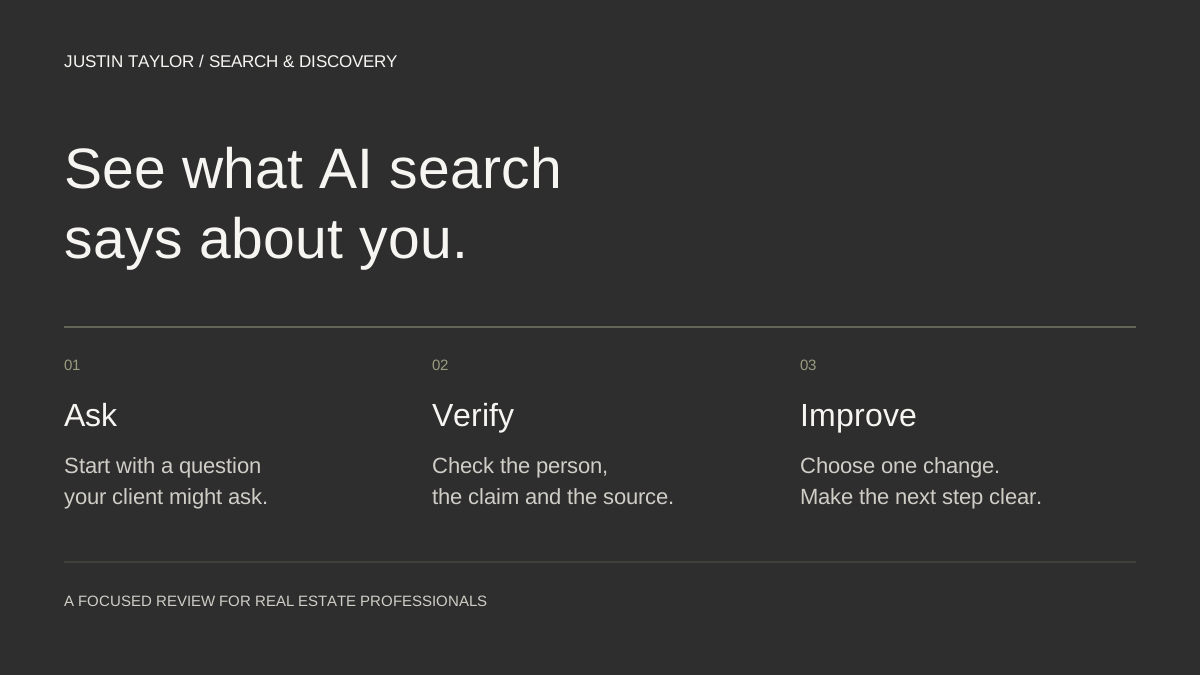
To check your AI search visibility as a real estate agent, start with a small set of questions about your name, market and expertise. Record the answers, open the cited pages and check whether the information describes the right person. Then choose a specific correction you can make.
That is a more useful starting point than repeatedly asking an AI tool to name the “best agent” in your city. A recommendation can vary, and a name appearing in an answer does not tell you whether a prospective client will find accurate information or a working contact link.
HubSpot’s guide to diagnosing AEO gaps, updated October 1, 2026, makes the case for investigating why a website is missing from AI answers before deciding what to change. The workflow below applies that question to an agent’s public identity and client experience, with original real estate examples.
Choose questions a prospective client might ask
Set aside about 30 minutes for a first pass: five minutes to choose questions, ten to collect answers, ten to check sources and five to select your next action. This is a starting exercise, not a complete technical audit.
Use your professional name and the location where you actually work. If your name is common, add your brokerage or team in one question so you can compare an ambiguous search with a more specific one. Keep a separate question that does not name you; that tests discovery around a subject rather than recognition of your identity.
| Question to try | What to examine |
|---|---|
| Who is [full name], the real estate agent in [city]? | Whether the answer describes you or someone with a similar name. |
| What brokerage or team does [full name] in [city] work with? | Whether current and former affiliations are distinguished. |
| Where can I find [full name]’s official website and contact information? | Whether the destination works and belongs to you. |
| What should a buyer prepare before a home-search visit to [city]? | Which resources appear for a question your content could help answer. |
| Does [full name] have a guide to planning a home-search visit? | Whether a specific resource you actually publish is identified correctly. |
Replace the visit-planning topic with a question you regularly answer. Do not ask about a specialty or guide you do not have and then treat its absence as an error.
Record what appeared, including the sources
Choose one AI search experience to start. Use a new conversation and record whether web search is enabled, which tool or mode you used, and whether you are signed in. Keep those conditions as consistent as possible when repeating the check. A fresh conversation reduces prior-chat context; it does not make the result a universal view of what everyone sees.
Save the exact prompt and answer rather than a memory of the result. If sources are shown, open them. An answer can name you while linking to a directory, a former employer or an entirely different person.
| Field | What to record |
|---|---|
| Test | Date, exact question, tool, mode and account conditions. |
| Identity | Correct person, uncertain match, different person or no mention. |
| Claim | The specific statement to verify: role, location, service or contact detail. |
| Evidence | Answer screenshot and the exact source URLs displayed. |
| Visitor destination | Your website, a third-party page, a broken link or no link. |
| Action | The correction, who can make it and the date you verified the public result. |
Keep a mention and a website citation in separate fields. Being named is one observation; having a working link to your own resource is another. An answer without visible citations gives you less evidence about its origin, so do not assume a particular page caused it.
Verify the claim before changing your marketing
Read the source in context. Check its publication date, whether it describes a past event, and whether the person, company and geography match. An old article can be accurate even when a current AI summary uses it incorrectly.
Consider a fictional agent, Alex Morgan, who moved from Harbor Realty to Summit Homes. A dated announcement saying Alex joined Harbor Realty in 2021 is valid career history. A current team biography still listing Alex at Harbor Realty is a different issue. The first may need clearer context in Alex’s own history page; the second needs a profile correction if Alex can obtain one.
Before editing, ask:
- Is the underlying information wrong, or has the answer removed its date or context?
- Does the source refer to the same Alex Morgan?
- Can a reader find a clear, current explanation on Alex’s own website?
- Does the linked contact route still reach Alex?
Do not copy an AI-generated credential, award or market specialty into your biography just because it sounds favorable. Verify it first. The same standard applies to a flattering answer and an inaccurate one.
Fix the path a prospective client would follow
Prioritize an error that interrupts contact or misidentifies you. A website button leading to an expired domain deserves attention before a cosmetic difference between profile descriptions.
Your biography should give a reader a clear reference point: your professional name, current role, accurate affiliation, the areas you serve and how to contact you. Link to the profiles you actually maintain. You do not need to repeat an identical paragraph everywhere, but the underlying facts should agree.
A simple starting structure is:
[Full name] is a real estate agent with [current brokerage or team], serving [actual service areas]. [Name] helps [clients you actually serve] with [services you provide]. Find current guides at [resource page] or contact [name] through [contact page].
Adapt that structure to your actual work and brokerage requirements. If you have concurrent roles, explain each one rather than making a reader choose between apparently conflicting biographies.
For a missing topic, first review the page you already have. A visit-planning guide might need a useful preparation checklist, an explanation of how to organize appointments, and a realistic example of a two-day visit. Those additions serve a reader even if the next AI answer never cites the guide. Use the content-cluster guide to decide where a deeper article belongs.
If an outside publisher cannot update a historical article, keep your current biography clear and link to relevant history where helpful. A citation audit can organize the remaining corrections; see the local-profile audit worksheet.
Check the technical basics without assuming schema is the answer
For Google’s AI Overviews and AI Mode, a supporting page must be indexed and eligible to appear with a search snippet. Google says the normal SEO foundations still apply, and there is no special AI schema or new AI text file required for inclusion. Eligibility does not guarantee an appearance. See Google’s guidance on AI features.
Ask your website provider to check three things: the relevant page is accessible to search crawlers, its important information is readable text, and its structured data agrees with the visible biography. If profile markup is used, the main person should be you; a team’s channel should not be identified as your personal profile. Google’s ProfilePage documentation describes person identity and alternate-profile references.
Use Search Console’s URL Inspection tool for the individual page. An indexed homepage does not establish that every article is indexed, and a successful live test is different from confirmation that Google has indexed the URL. These checks diagnose Google access and indexing; they do not prove how every other AI service will use the page.
Review changes without chasing every answer
Repeat your original questions on a manageable schedule, such as weekly for a month. Keep a record of website edits between checks. If you change the wording of a question, save it as a separate test so you can still compare the original.
Review the actual observations: whether the correct person appears, whether the current affiliation is described accurately, and whether the links take a reader somewhere useful. Keep website inquiries alongside those observations. A small set of prompts is a working sample, not a market-wide ranking or a reliable prediction of lead volume.
Improvement after an edit is worth recording, but the timing alone does not prove the edit caused it. Different sources, product updates and response variation may also affect what appears.
Finish your first review with one concrete task: repair a contact link, clarify a biography or improve one guide. Give it an owner and verify the public page after the change. That turns a vague concern about AI visibility into work you can complete and evaluate.
Sources & further reading
Platform guidance and research referenced in this article. Reviewed October 4, 2026.

Growth & Strategy Manager at Inspire Title Team | WFG Title. Marketing and AI guidance for real estate professionals.